News
Automotive FMEA in Practice: How to Prevent Failures Before They Become Costly
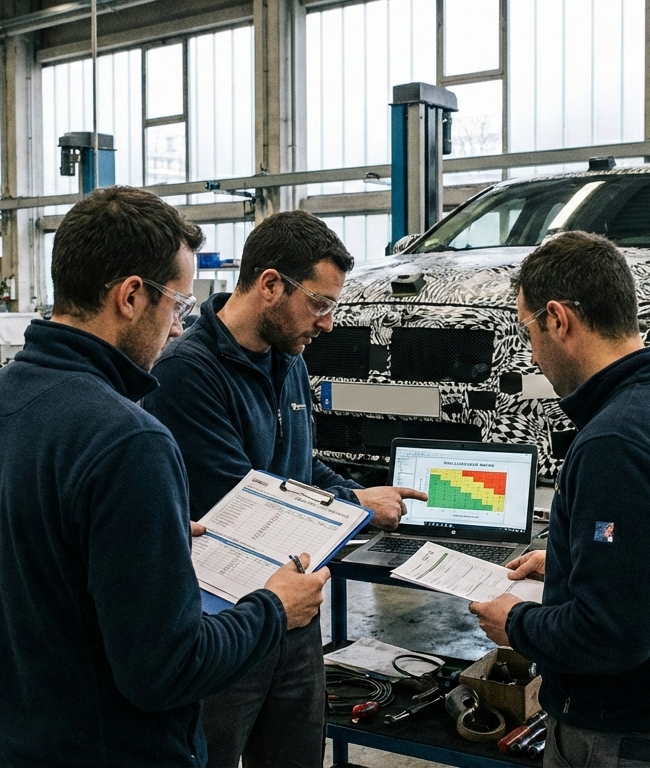
A practical guide to applying Failure Mode and Effects Analysis (FMEA) in automotive development to reduce rework, control risk, and improve product reliability.
In automotive engineering, failures rarely occur without early warning signs. Most issues that impact validation, production, or field performance were previously identifiable as potential risks. The difference lies in whether those risks were properly analyzed and mitigated.
This is where Automotive FMEA becomes essential. When applied correctly, Failure Mode and Effects Analysis allows engineering teams to anticipate failure modes, reduce development costs, and strengthen product quality before launch.
What Is FMEA in Automotive Development?
FMEA (Failure Mode and Effects Analysis) is a structured risk management methodology used to identify potential failure modes in products or processes, evaluate their impact, and define preventive actions.
In the automotive industry, two main types are commonly applied:
DFMEA (Design Failure Mode and Effects Analysis) – focused on product design risks
PFMEA (Process Failure Mode and Effects Analysis) – focused on manufacturing and process risks
When integrated into the automotive development process, FMEA improves technical decision-making, prioritizes engineering efforts, and supports compliance with quality standards such as IATF 16949 and APQP requirements.
Why Late Failure Detection Increases Cost
Identifying failures during validation testing or after Start of Production (SOP) significantly increases correction costs. Engineering changes at advanced stages often require redesign, tooling adjustments, supplier rework, and production rescheduling.
According to industry best practices, the cost of correcting a defect increases exponentially as the product lifecycle progresses. Addressing a risk during the concept phase is far more cost-effective than reacting during production or in the field.
Proactive failure prevention protects project margins, timelines, and brand reputation.
How Severity, Occurrence, and Detection Drive Risk Prioritization
The strength of Automotive FMEA lies in the structured evaluation of three key criteria:
Severity – the impact of the failure on the customer or system
Occurrence – the likelihood of the failure happening
Detection – the probability of identifying the issue before it reaches the customer
By calculating risk priority and analyzing root causes, engineering teams can implement preventive actions early. This structured approach strengthens product reliability and supports robust quality planning.
Integrating FMEA with the Product Development Lifecycle
For FMEA to deliver real value, it must be integrated into the full automotive product development lifecycle. Design changes, supplier updates, engineering modifications, or process adjustments require continuous review of the risk analysis. A static FMEA document provides limited protection. A continuously updated FMEA becomes a strategic engineering tool that aligns design, manufacturing, and quality teams under a unified risk management framework.
Cross-Functional Collaboration Improves Risk Identification
Effective FMEA implementation requires multidisciplinary participation. Product engineering, manufacturing engineering, quality teams, supplier representatives, and validation specialists contribute different perspectives on potential failure modes.
Cross-functional collaboration increases the likelihood of identifying hidden risks and enhances the overall robustness of the vehicle development program.
FMEA as a Competitive Advantage in Automotive Engineering
Companies that apply Automotive FMEA systematically demonstrate technical maturity, structured risk management, and compliance readiness. This strengthens audit performance, customer confidence, and program stability.
Failure prevention is not only a quality requirement. It is a business strategy that reduces waste, improves predictability, and sustains long-term profitability.
Partner with Global Group
If your organization is looking to strengthen risk management in automotive development, reduce rework, and improve product reliability, Global Group provides engineering expertise and structured methodologies tailored to your needs. Contact our team to learn how to integrate DFMEA, PFMEA, and advanced risk management practices into your development process.
Engineering excellence starts with prevention.