News
Automotive Cybersecurity: Why Connected Vehicles Must Also Be Protected
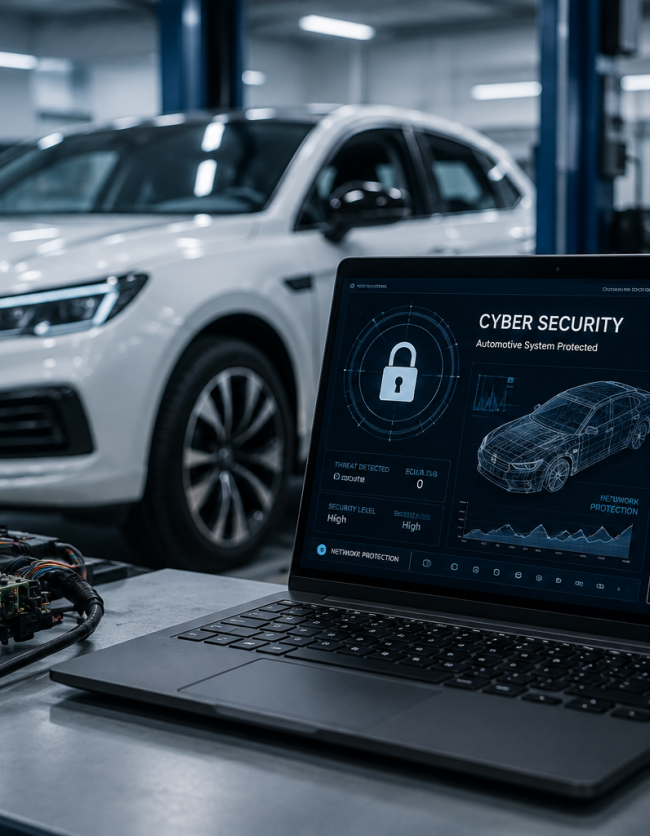
As vehicles become increasingly software-driven and connected, cybersecurity is becoming an essential part of the entire automotive development lifecycle.
Automotive cybersecurity: a new dimension of engineering
The automobile is no longer just a collection of mechanical systems. Modern vehicles combine embedded software, sensors, electronic control units, connectivity, applications, and remote updates.
This evolution has enabled new levels of safety, comfort, efficiency, and performance. At the same time, it has increased the number of digital interfaces that must be considered throughout vehicle development.
This is where automotive cybersecurity becomes increasingly important.
What is automotive cybersecurity?
Automotive cybersecurity refers to the processes, technologies, and engineering practices used to identify, assess, and mitigate cybersecurity risks associated with a vehicle’s electronic and digital systems.
And it goes beyond protecting personal data.
In a connected vehicle, multiple systems exchange information with each other and with external environments. A vulnerability can affect confidentiality, integrity, availability, and certain vehicle functions.
Cybersecurity, therefore, is no longer exclusively an IT concern. It has become part of automotive engineering itself.
More connectivity requires greater attention to risk
Bluetooth, Wi-Fi, mobile applications, infotainment systems, cellular communication, diagnostic interfaces, and Over-the-Air (OTA) updates are just some of the technologies expanding vehicle connectivity.
Each new interface creates opportunities for better user experiences and functionality, but it must also be considered from a cybersecurity perspective.
This has strengthened the importance of security by design: addressing cybersecurity requirements and risks from the early stages of development instead of treating protection as something to be added after the product is complete.
What is the role of ISO/SAE 21434?
ISO/SAE 21434 is one of the key international references for automotive cybersecurity engineering.
The standard addresses cybersecurity risk management throughout the lifecycle of electrical and electronic systems in road vehicles, covering activities from concept and development through production, operation, maintenance, and decommissioning.
The principle is clear: automotive cybersecurity must be treated as a continuous engineering process.
What about UN R155 and UN R156?
Automotive regulations have also evolved alongside vehicle connectivity.
UN R155 establishes requirements related to vehicle cybersecurity and manufacturers’ Cyber Security Management Systems (CSMS). UN R156, in turn, addresses software update management systems and vehicle software update processes.
Together, these frameworks reinforce an important shift: protecting connected vehicles requires more than technology. It also requires governance, validation, structured processes, and risk management.
Cybersecurity continues after the vehicle reaches the road
One of the defining characteristics of increasingly software-driven vehicles is that the product can continue evolving after production.
Software updates can introduce functionality, improve existing systems, and address vulnerabilities. As a result, monitoring, risk assessment, validation, and secure update processes remain relevant throughout the vehicle lifecycle.
In this new reality, vehicle development does not simply end at launch.
Engineering and cybersecurity must evolve together
As software becomes more important to vehicle architecture, collaboration across disciplines becomes essential.
Systems engineering, electronics, software, validation, quality, and risk management increasingly need to operate as interconnected capabilities.
For the automotive industry, the challenge is no longer simply to develop more connected vehicles. It is to deliver connectivity supported by reliability, robust processes, and effective validation.
Global Group brings together automotive engineering capabilities including comprehensive vehicle engineering, durability and validation testing, engineering outsourcing, supplier quality, and product development expertise.
As the automotive industry becomes increasingly software-driven, one idea becomes clear: The vehicle of the future will not only be more connected. It will need to be trusted at every connection. And transforming that complexity into confidence is increasingly an engineering mission.